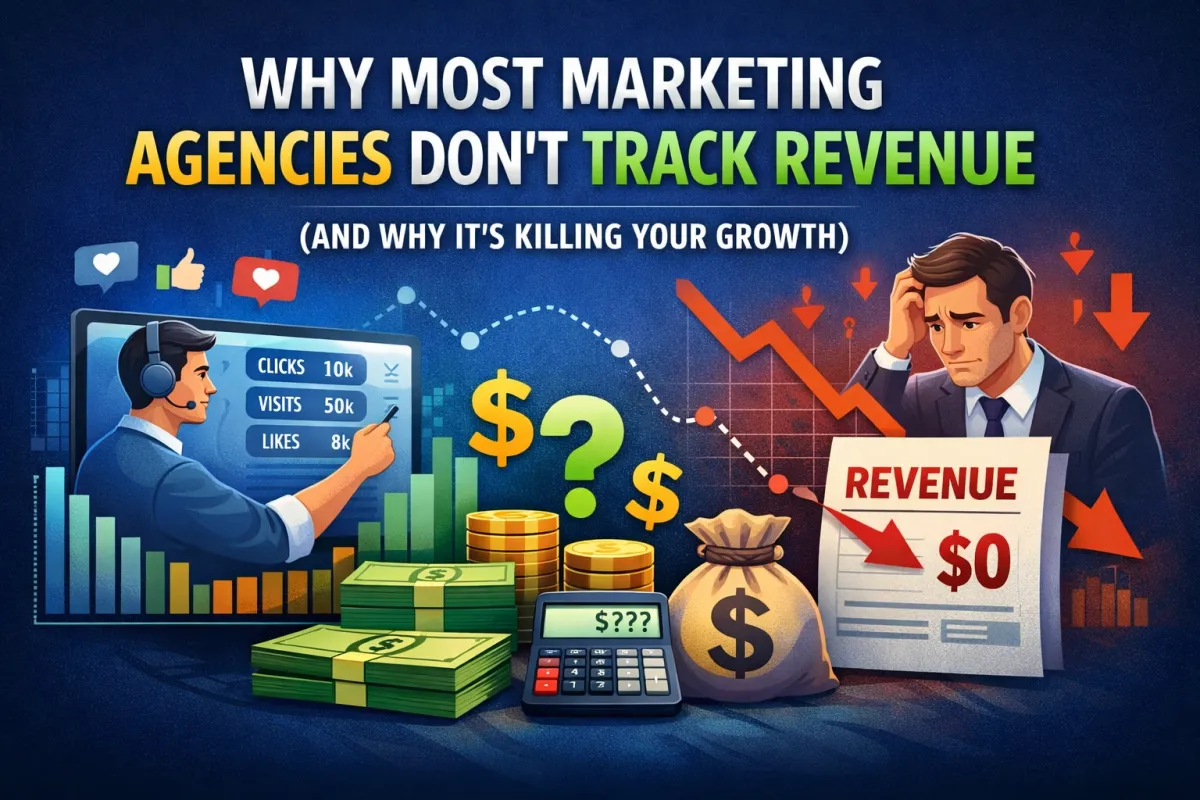
Why Most Marketing Agencies Don’t Track Revenue (And Why It’s Killing Your Growth)
Why Most Marketing Agencies Don’t Track Revenue (And Why It’s Killing Your Growth)

Most marketing agencies promisemore leads,better traffic, andhigher engagement.
But here’s the uncomfortable truth:
Very few agencies can tell you how much money their marketing actually made you.
And that single gap—not tracking revenue—is quietly killing business growth across nearly every industry.
If your marketing partner can’t tie their work directly toclosed deals, booked appointments, and real dollars, you’re not investing in growth—you’re gambling.
The Real Problem: Marketing Has Been Separated From Money
Marketing didn’t used to be disconnected from revenue.
Traditionally, marketing existed to:
Generate sales
Increase customer lifetime value
Improve profitability
Today, many agencies define success using metrics like:
Clicks
Impressions
Website traffic
Cost per lead
Engagement rates
These metrics may look impressive—but they often havelittle or no correlation to revenue.
Why Most Marketing Agencies Don’t Track Revenue
1. Revenue Tracking Requires Operational Integration
Tracking revenue means understanding:
Your CRM
Your sales pipeline
Your follow-up systems
Sales team behavior
Close rates and deal size
Most agencies avoid this because it requiresreal accountability.
2. Vanity Metrics Are Easier to Defend
If revenue drops, agencies tracking money are responsible.
If traffic goes up, agencies can say:
“Marketing is working. Sales must be the problem.”
This protects the agency—but hurts your business.
3. Most Agencies Don’t Understand Sales
Revenue tracking requires:
Funnel math
Conversion analysis
Objection handling insight
Attribution modeling
Most agencies are media buyers—not growth operators.
4. Revenue Tracking Exposes Broken Offers
When revenue is tracked, uncomfortable truths appear:
Weak offers
Poor pricing
Slow follow-up
Broken sales processes
Agencies that avoid revenue tracking never face these realities.
Why Not Tracking Revenue Is Killing Your Growth
You Can’t Scale What You Don’t Measure
Without knowing:
Cost per booked appointment
Cost per closed deal
ROI by channel
Growth becomes guesswork.
You Cut the Wrong Things
Businesses often pause campaigns thatfeelexpensive—
even when they’re the most profitable.
Revenue tracking removes emotion from decisions.
Marketing and Sales Stay Misaligned
When marketing isn’t tied to revenue:
Sales blames lead quality
Marketing blames follow-up
Leadership lacks clarity
Revenue tracking forces alignment.
You Attract the Wrong Customers
High lead volume without revenue insight produces:
Low-intent prospects
Price shoppers
Tire-kickers
Revenue-driven marketing attractsbuyers, not browsers.
What Revenue-Driven Marketing Actually Looks Like
True growth marketing tracks theentire customer journey:
Ad impression
Click
Form fill or call
Appointment booked
Appointment showed
Deal closed
Revenue collected
Lifetime value
Retention and upsells
Anything less is incomplete.
The Metrics That Actually Matter
If your agency can’t report these, you don’t have a growth partner:
Cost per booked appointment
Cost per closed deal
Revenue per lead
ROI by channel
Sales cycle length
Funnel conversion rates
Pipeline velocity
Customer lifetime value (LTV)
Why Revenue Tracking Changes Everything
Better Decisions
You know exactly where to invest—and where to cut.
Stronger Sales Performance
Revenue data improves:
Messaging
Offers
Sales scripts
Follow-up speed
Predictable Growth
Revenue tracking turns marketing into arepeatable system, not a gamble.
Why Trivium Marketing Tracks Revenue
AtTrivium Marketing, we don’t optimize for vanity metrics.
We track:
Revenue
ROI
Profitability
Scalability
We integrate directly with:
CRM systems
Sales pipelines
Calendars
Attribution tracking
Becausemarketing without revenue is just noise.
Ask Your Agency This One Question
Ask:
“How much revenue did your marketing generate last month?”
If the answer is:
“We don’t track that”
“That’s a sales issue”
“Here are your clicks instead”
You already know the problem.
Final Thoughts: Growth Requires Accountability
Revenue tracking isn’t optional anymore.
It’s the difference between:
Activity vs results
Busy vs profitable
Guessing vs scaling
Agencies that avoid revenue tracking aren’t protecting you—they’re protecting themselves.
Ready to Track What Actually Matters?
If you want marketing that:
Ties directly to revenue
Scales predictably
Eliminates guesswork
Aligns marketing and sales
Trivium Marketingwas built for that.
👉Book a strategy call and uncover where your growth is leaking.


